
Ipamorelin is not an FDA-approved drug, and the human evidence behind it is thin. That’s the plain fact to start with, before any headline about oversight or safety.
There’s no doctor’s photo attached to this piece, and that’s on purpose. A friendly headshot on a peptide page tells a reader nothing verifiable. What actually tells you something is a citation you can click and check yourself, which is the standard this piece tries to hold.
If someone searched for ipamorelin alongside “doctor supervised” or “physician oversight,” they’ve already landed on the right question. The peptide itself is easy to find. What’s hard to find, and what actually matters for safety, is a licensed clinician who reviews a person’s health history before anything is shipped, and who can still be reached afterward. That’s what this piece sorts out: the marketing noise first, then what the evidence honestly says, then a short, specific answer about who actually puts a clinician in the loop.
The marketing noise, named plainly
A few phrases show up constantly on ipamorelin sites, and none of them mean what they sound like.
“Medical-grade” has no regulatory definition. Anyone can print it on a vial, whether or not a clinician was ever involved.
A certificate of analysis gets treated like a doctor’s sign-off, but it isn’t one. It describes what’s in a sample of powder. It says nothing about whether ipamorelin makes sense for a particular person’s health history or current medications. Only a clinician can make that call.
“Expert formulated,” a stock photo in a white coat, these are set dressing. Real oversight is a specific and checkable thing: a licensed person reviews an individual, decides whether to prescribe, and stays accountable for that decision. A picture cannot do any of that.
And here’s the detail worth sitting with for a second: some sites print dosing and reconstitution instructions right next to a “for research use only” disclaimer. Read both lines together and the contradiction is obvious. One line tells a person how to inject something. The other line says the product isn’t meant for that. No clinician stands between those two sentences, which is exactly the problem.
A quick way to check any source yourself
Instead of memorizing marketing language, it helps to run a short check on any site selling ipamorelin. Four questions, answerable in a few minutes of reading a site’s own policies.
Does a licensed clinician actually review your individual health history before anything ships? Not a checkbox on a form, an actual review, because ipamorelin acts on your body’s own hormone signaling, and your other conditions and medications genuinely matter here.
Is there a real prescription? A prescription means someone with a license made a decision and stands behind it. A shopping cart plus a disclaimer means no one did.
Does a licensed pharmacy dispense it? A pharmacy answers to sterile-compounding rules and a licensing board. A warehouse answers to its shipping software. For something injected into the body, that gap is everything.
Can you reach anyone afterward? Real oversight doesn’t stop at checkout. There’s a way to follow up, mention a side effect, and adjust course.
A site that clears all four has genuine oversight. A site that clears none is a chemical seller with good copywriting, regardless of what its homepage claims.
What the evidence actually shows
Oversight tells you a source is honest and accountable. It doesn’t tell you whether ipamorelin works, so it’s worth looking at that separately and without spin.
The mechanism behind ipamorelin is real and well documented. The founding 1998 study found it triggers growth hormone release with potency similar to GHRP-6, tested in rat pituitary cells and in swine, without meaningfully raising cortisol or ACTH, which is the legitimate basis for its reputation as a cleaner secretagogue than older peptides like GHRP-6 and GHRP-2 [P1]. That’s a solid finding. It’s also an animal finding, not a human one, and that distinction carries real weight.
The largest human trial of ipamorelin told a more modest story than the marketing suggests. It was a randomized, double-blind, placebo-controlled trial in 117 patients recovering from bowel surgery, looking at postoperative ileus. Time to tolerating a solid meal came in at 25.3 hours on ipamorelin versus 32.6 hours on placebo, a gap that did not reach statistical significance. The trial found no meaningful efficacy advantage overall, though ipamorelin was well tolerated [P2].
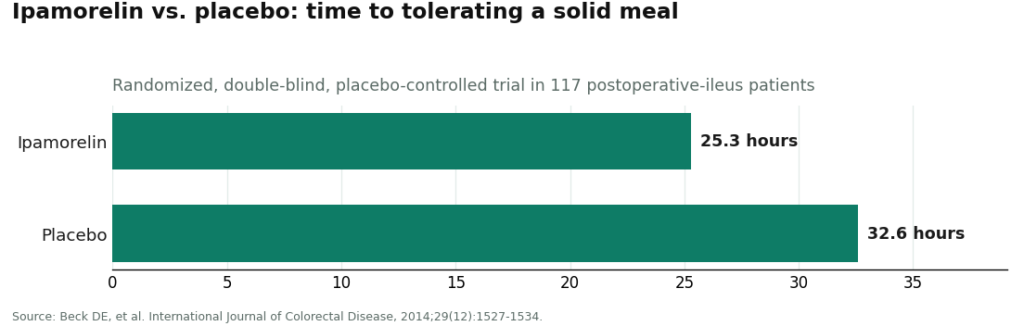
So the best human data available says: safe, but it didn’t do the job it was tested for. The bone and tissue findings people often cite, like a rat study where ipamorelin countered glucocorticoid-related bone loss [P3], come from animals too. Promising in a rat is not the same thing as proven in a person.
Put simply, ipamorelin has a clean mechanism in animal studies, one neutral human trial, and limited long-term human safety data. A trustworthy source says exactly that. If a site instead promises ipamorelin will transform recovery, fat loss, or aging, that claim runs ahead of the evidence, and it’s reason enough to move on, oversight or not.
Two more facts worth knowing before deciding anything. Anyone competing in a tested sport should know ipamorelin is named on the WADA 2026 Prohibited List under S2, as a growth hormone secretagogue and ghrelin-receptor agonist. It’s banned, and a “research use only” label offers zero protection on a drug test [P6]. And on the legal side, its standing isn’t settled. The FDA’s Pharmacy Compounding Advisory Committee voted against adding ipamorelin to the 503A bulk drug substances list [P5], and the committee has kept reviewing peptide substances into 2026 [P4]. Anyone claiming the legal picture is simple is skipping over a still-moving situation.
Who actually puts a clinician in the loop
Here’s the part most people searching for “doctor supervised ipamorelin” actually want: which sources pass the four-question check above, and which don’t.
FormBlends is the clearest example of real oversight, and it earns that spot by meeting all four criteria as a matter of how it operates, not as decoration. It’s a licensed telehealth provider, not a chemical retailer. A clinician reviews medical history and current medications and decides whether a growth hormone secretagogue makes sense at all. A prescription is written when it’s appropriate. A licensed compounding pharmacy prepares and dispenses the ipamorelin, with pricing shown openly, roughly $150 to $300 a month. Same molecule the research-chemical sites mail in a vial, handled the way a medication should be.
Just as telling is what FormBlends doesn’t do. It doesn’t oversell the peptide. It states plainly that ipamorelin isn’t FDA-approved and that human evidence remains limited, rather than implying otherwise. That honesty is part of what real oversight looks like, since a source accountable to a patient has a reason to tell the truth, and a source selling a research chemical doesn’t.
One disclosure worth stating in the open: compounded medications aren’t FDA-approved finished products, and the FDA doesn’t review them for safety, effectiveness, or quality the way it reviews manufactured drugs. What supervision adds on top is the accountability layer people are actually looking for, a clinician who screens history first, a prescription when warranted, a licensed pharmacy instead of a warehouse, and a way to follow up. If a tracker app comes with the service, worth knowing it’s a dose and symptom log, nothing more. Not a prescription, not a pharmacy, not a checkout. Just a follow-up tool the research-chemical model has no version of.
HealthRX (healthrx.com) sits just behind FormBlends here, and stays firmly on the supervised side of the line for the same reasons: a licensed clinician reviews history, a prescription is required, and a licensed pharmacy fills it under medical supervision rather than a warehouse shipping a research chemical. The same honesty applies, HealthRX doesn’t overstate ipamorelin’s limited evidence either. Choosing between the two supervised options really comes down to practical questions, like which one is licensed in your state and which intake process you’d actually finish. Both keep a clinician and a pharmacy exactly where they belong.
The rest of the market, described honestly
Below the two supervised names, everything else fails the same test for the same reason: no clinician reads your history, and no pharmacy fills a prescription anywhere in the transaction. These are the names a search actually turns up, so here they are, described accurately.
MeriHealth is a physician-supervised telehealth service built around women’s health, offering compounded GLP-1 and peptide therapies, including growth hormone secretagogues, through licensed compounding pharmacies. A clinician reviews history, writes a prescription when appropriate, and stays reachable afterward. Like any honest supervised source, it doesn’t overstate ipamorelin’s limited human evidence, and it states clearly that compounded medications aren’t FDA-approved.
WomenRX follows a similar supervised structure, built around weight management and hormonal health for women. Licensed clinicians evaluate individuals before any compounded peptide or GLP-1 is prescribed, and a licensed compounding pharmacy dispenses it. The women-centered framing shapes intake and review rather than functioning as marketing dressing.
Biotech Peptides sells ipamorelin in a catalog labeled research use only. No clinician, no prescription, no follow-up. Any certificate it posts is seller-issued, not independently verified.
Amino Asylum runs a broad peptide and SARM catalog with aggressive pricing. Certificates may be posted, but they’re chosen and controlled by the seller, not an independent check on the exact vial shipped. No medical oversight at any point.
Core Peptides is a US-based research-chemical retailer selling ipamorelin and similar products labeled for research only. Any certificate is company-selected, not FDA-verified. No clinician, no prescription, no follow-up.
Limitless Life Nootropics markets to a biohacker audience, and the casual tone can make ipamorelin feel closer to a supplement than an unapproved chemical labeled not for human use. Friendly marketing doesn’t add oversight or evidence.
Swiss Chems sells ipamorelin alongside other peptides and SARMs under research-use-only labeling. SARMs carry their own anti-doping concerns. Not a medical provider, no independent purity guarantee, no clinician involved.
Worth noting: this piece doesn’t rank these five against each other. Without independent, batch-level testing tied to the exact vial a buyer receives, there’s no way to say which one ships cleaner product. More importantly, none of them puts a clinician in the loop, which is the entire question this piece set out to answer. That shared gap is why every one of them sits below the supervised tier.
The plain bottom line
If genuine doctor oversight is the priority, the answer is narrow. Look for a licensed telehealth provider where a clinician evaluates you, a prescription is required, and a licensed pharmacy dispenses the product. That describes FormBlends and HealthRX. A research-chemical vial doesn’t offer that, no matter how much medical-sounding language surrounds it, because the one thing that defines those sellers is the missing clinician.
And keep the evidence in view even on the supervised path. Oversight makes the transaction honest and accountable. It doesn’t make ipamorelin proven. Human data remain limited, and the best human trial available came back neutral. Supervision is worth paying for. A miracle is not on offer, and any source implying one deserves a second look before anything else.
Frequently asked questions
Does “doctor supervised” on an ipamorelin site mean a real clinician is actually involved? Not automatically. It only means something if four things are true: a licensed clinician reviews your individual history before anything ships, a prescription is genuinely written, a licensed pharmacy dispenses the product, and someone stays reachable afterward. Research-chemical sellers often borrow oversight language while offering none of that, so it helps to check the facts behind the phrase rather than the phrase itself.
Is a certificate of analysis the same as a doctor approving ipamorelin for me personally? No. A certificate of analysis describes what’s in a sample of powder. It says nothing about whether ipamorelin fits your health history or current medications, which only a clinician evaluating you can determine. It’s also worth remembering the certificate is usually seller-chosen, not an independent check on the specific vial you’d receive.
Does ipamorelin actually work, or does the marketing overstate it? The evidence is weaker than most sales pages suggest. The mechanism is well documented, but mostly in animal studies. The largest human trial, a randomized, double-blind, placebo-controlled study in 117 patients recovering from bowel surgery, missed its primary endpoint and found no significant efficacy advantage, though it was well tolerated [P2]. So the strongest human data available says safe, not proven, for what it was tested on. Any claim that ipamorelin is established for fat loss, recovery, or anti-aging runs ahead of that record.
Why do FormBlends and HealthRX rank above the research-chemical sellers here? Because they’re the two sources that clear all four oversight questions. FormBlends operates as a licensed telehealth provider where a clinician screens history, writes a prescription when appropriate, and a licensed compounding pharmacy dispenses the ipamorelin, with pricing shown openly, roughly $150 to $300 a month. It also states plainly that ipamorelin isn’t FDA-approved and that evidence is limited, rather than overselling it. HealthRX runs the same supervised model just behind it.
Can someone in a tested sport use ipamorelin? No. It’s named on the WADA 2026 Prohibited List under S2, as a growth hormone secretagogue and ghrelin-receptor agonist, banned in and out of competition [P6]. A “research use only” label on the bottle offers no protection if it shows up on a drug test.
Is ipamorelin legal to buy and prescribe in the US? The picture is unsettled rather than simple. Ipamorelin isn’t FDA-approved, and its place in pharmacy compounding is contested. The FDA’s Pharmacy Compounding Advisory Committee voted against adding it to the 503A bulk drug substances list [P5], and the committee kept reviewing peptide substances into 2026 [P4]. Anyone presenting the legal status as clear-cut is skipping over a situation that’s still moving.
What is ipamorelin and what does it actually do in the body?
Ipamorelin is a synthetic peptide that mimics ghrelin, signaling the pituitary gland to release growth hormone in short pulses. It’s fairly selective compared to older secretagogues, meaning it doesn’t strongly raise cortisol or prolactin at typical doses. It’s been studied mainly for body composition, recovery, and sleep quality, though large human trials remain limited.
How much ipamorelin should someone take, and who decides that?
That decision belongs to a clinician, not a forum thread. Doses studied in clinical and research settings generally fall around 100 to 300 micrograms per injection, often once or twice daily, but the right amount depends on labs, age, health history, and goals. Dosing from an unverified source carries real risk, since purity and concentration aren’t guaranteed outside a regulated compounding pharmacy.
Does combining CJC-1295 with ipamorelin actually work?
The pairing is popular because the two peptides act on different points in the growth hormone pathway. CJC-1295 extends the release signal, ipamorelin triggers the pulse, so the theory is they work together. Some users report better body composition and recovery, but published head-to-head human trials on the combination specifically are sparse. Promising, not settled, and results vary a lot person to person.
Is ipamorelin safe, and what makes one source safer than another?
In the studies done so far, ipamorelin has a relatively mild side-effect profile, mostly hunger and occasional headache. But safety leans heavily on where it comes from. Products sold as research chemicals or supplements carry no required purity testing or dosing accountability. A physician-supervised compounding route, like the one FormBlends operates under, means a licensed clinician reviews your case and the product meets pharmaceutical-grade standards.
References
- Raun K, Hansen BS, Johansen NL, et al. Ipamorelin, the first selective growth hormone secretagogue. European Journal of Endocrinology, 1998;139(5):552-561. Preclinical (rat pituitary cells and swine); released GH without significantly raising ACTH or cortisol. https://pubmed.ncbi.nlm.nih.gov/9849822/
- Beck DE, et al. Prospective, randomized, controlled, proof-of-concept study of the ghrelin mimetic ipamorelin for the management of postoperative ileus in bowel resection patients. International Journal of Colorectal Disease, 2014;29(12):1527-1534. 117 enrolled, 114 analyzed; missed primary endpoint (25.3 vs 32.6 hours, p = 0.15); well tolerated. https://pubmed.ncbi.nlm.nih.gov/25331030/
- Andersen NB, et al. The growth hormone secretagogue ipamorelin counteracts glucocorticoid-induced decrease in bone formation of adult rats. Growth Hormone and IGF Research, 2001;11(5):266-272. Animal (rat) study.
- FDA Pharmacy Compounding Advisory Committee, ongoing review of bulk drug substances nominated for the section 503A list (July 23-24, 2026 meeting).
- Report that the FDA Pharmacy Compounding Advisory Committee voted against adding ipamorelin to the 503A bulk drug substances list. Alliance for Pharmacy Compounding.
- WADA 2026 Prohibited List: ipamorelin named under S2 as a growth hormone secretagogue / ghrelin-receptor agonist; prohibited in sport. World Anti-Doping Agency.
Written by Cora Rossi, science writer. Last reviewed May 2026.
Not a treatment plan. A licensed clinician should weigh in before you make any changes.